

Arkansas’ fiscal session begins today! At noon on April 8, 2026, the legislators will convene to discuss what to do with our tax dollars. Let’s dive in with a quick overview on how the fiscal session works, what we expect to see, and (our favorite) some shameless predictions about how some tense dynamics between legislators and the executive branch may impact the session.
How Does this Session Work?
Fiscal sessions can’t last longer than 30 days, thankfully, though legislators can extend it by 15 days with a ¾ vote. They also can’t consider any bills that don’t deal with appropriations unless ⅔ of the legislators agree to take up the bill.
Usually, this isn’t a problem, but you may remember this became a real fight in 2024. Several legislators were desperate to close loopholes that had allowed cryptocurrency mines to open willy-nilly across Arkansas. They mostly succeeded after an extended fight over whether to even take the bills up.
Legislators have historically been reluctant to take up non-appropriation bills during fiscal for a pretty good reason: if fiscal sessions regularly deal with non-appropriation matters, it doesn’t make much sense to continue to have distinct fiscal sessions.
The total budget the Governor has asked for clocks in around $6.7 billion, about a 3% increase from last fiscal session. An interesting tidbit: the 2024 budget was only a 1.7%, and true to form, the Governor has offered little explanation for this and simply claimed everything is fine! We won’t talk about the shrinking budget surplus, or the situation in the Middle East exploding gas and oil prices, or the general economic slump Arkansans have felt over the last year. It’s all fine!
What Are the Legislators’ Priorities This Year?
LEARNS
The LEARNS Act voucher system is likely to be the biggest point of contention this year. The program’s costs have already ballooned far beyond expectations, and Sen. Bart Hester (R-Cave Springs) stated that “I will never talk about whether we spent too much for EFAs.” Whether some in his caucus agree is another matter. Vouchers will bankrupt the state before too much longer, and legislators need to reign in spending before it’s too late. You can check out the projections below.
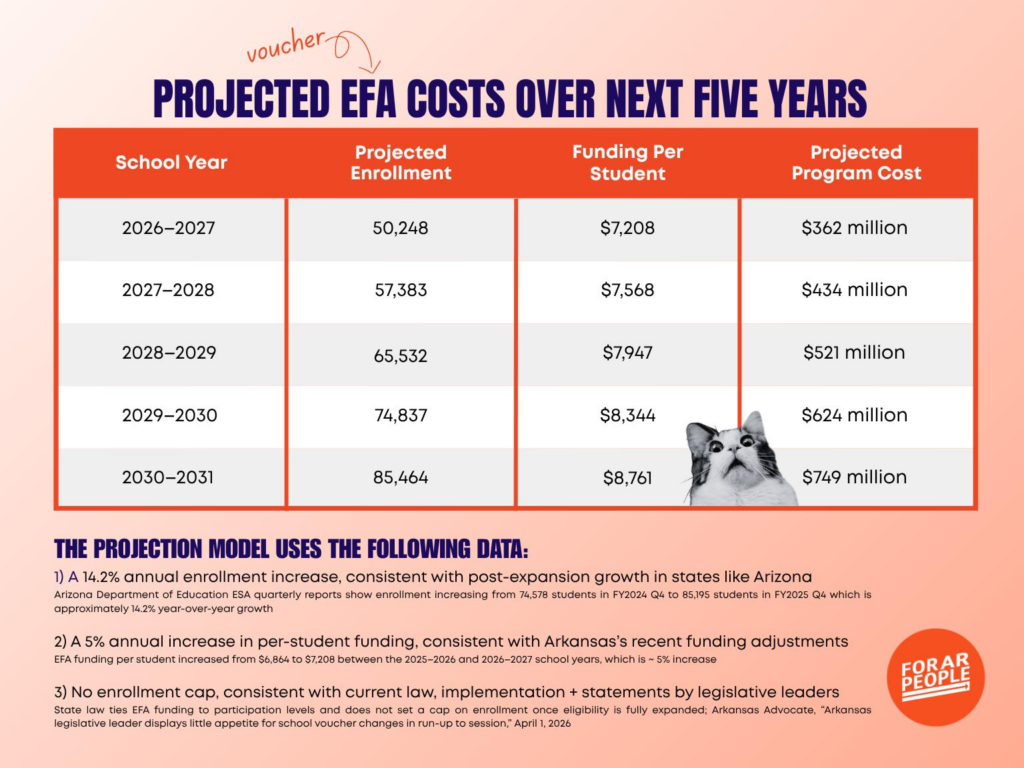
The biggest issue here? Lawmakers have consistently underestimated how much the program costs. That makes it tough to properly budget for it, and signals that spending should be more cautious. Despite Sen. Hester’s bloviations, a growing bipartisan chorus has sounded the alarm. Original LEARNS sponsor Sen. Breanne Davis (R-Russellville) spearheaded attempts last general session to implement more rules on acceptable uses for LEARNS dollars; it doesn’t seem fair that wealthy families can use our tax dollars for dressage lessons, does it?
This is likely to be the biggest fight of the session.
SNAP
President Trump’s so-called “One Big Beautiful Bill” dramatically changed the way SNAP (Supplemental Nutrition Assistance Program) will work in the coming years. The immediate priority for Arkansas is making up an $18 million shortfall that will cover administrative costs of the program. It’s essential Arkansas find this money; SNAP reimbursements from the government will be based on our error rate, and properly funding program oversight mechanisms will lower that rate. If we don’t get our error rate below 8% or so, we will increasingly have to pay our own SNAP benefits, or worse.
Put simply, failing to shoulder these new administrative costs may have compounding negative effects in the next few years.
It’s important to recognize that SNAP doesn’t just feed the people who use it; many small businesses across the state rely on folks shopping local using SNAP and EBT cards. With folks already feeling huge pinches at grocery store checkouts, our small businesses – and larger ones, too – heavily rely on folks using SNAP at their stores. Less money from the federal government here means less money in Arkansans’ pockets.
The new work requirements for SNAP have created an added wrinkle to this discussion. Job growth has not tracked with rising prices, so people get stuck between needing to avail themselves of SNAP benefits but being unable to meet the new work requirements. The result? More Arkansans – already some of the most food-insecure in the nation – going hungry and hungrier.
Pay Plan
Last year, Governor Sanders proposed, and the legislature passed, a plan to restructure state employee salary pay schedules. The plan was projected to cost about $139 million, and that bill is coming due. We don’t anticipate this being a huge problem for the legislature, as they seem aware that we’re losing talent to surrounding states that offer better benefits. This is likely to be funded with little grumbling.
Arkansas PBS
It’s been tough to keep up with what’s going on with Arkansas PBS. In December, the board voted to disaffiliate from the national organization, but after much public outcry, that disaffiliation was paused in March. Arkansas PBS has faced quite a bit of scrutiny in recent years, but they’ve turned things around.
In such a rural state with poor broadband coverage, Arkansas PBS represents some folks’ only lifelines outside our borders. The service provides essential education for kids and keeps seniors engaged in the world with its extensive travel and documentary programming.
This is one of the smaller dollar value appropriations at a mere $18 million, but with the pushback ArPBS has gotten in recent years, it’s likely to be a fight nonetheless. The vote to fund it required several tries in 2024.
Other bits and bobs
The Department of Corrections, one of the larger state agencies, likely won’t see any dramatics this year. The votes aren’t there for the Franklin County prison, thankfully, and the “law and order” people who run the show seem to be just fine funding the rest of DoC.
A bit of a kerfuffle popped up during the March budget meetings over a University of Arkansas board resolution that may result in increased prices for students. Expect a bit of debate over funding for the school. It’s been in the crosshairs lately over its firing of a professor who expressed disapproval over Israeli bombing of Palestine and the law school’s rescission of an dean offer to Emily Suski. The University is on thin ice with legislators right now.
An Increasingly Fraught Relationship
We’re straying away from fact-based reporting now. Gov. Sanders’ relationship with the legislature has undergone quite an evolution in the past two years. Cracks seemingly started to form during Lecterngate, when lawmakers approved an audit into the Governor’s spending and recommended sending it to local prosecuting attorney Will Jones (who, after having decided not to continue that investigation, just happened to receive money from the Governor’s friends in his failed reelection campaign).
The Franklin County prison debacle has widened those cracks dramatically. We don’t really know how the House feels about the situation, because the appropriation bill never got there, but two (or two and half?) camps seem to have formed in the Senate. There’s a bipartisan coalition opposing the prison, made up of most of the Democrats and classically conservative Republicans like Jimmy Hickey (R-Texarkana), Ron Caldwell (R-Wynne), and Terry Rice (R-Waldron). Ron Caldwell has thrown his hat in the ring for Senate President next session, and he may be able to squeak out a win if he can hold his coalition together and all the Democrats vote for him, which isn’t a guarantee. Rice narrowly lost the gig to Hester after the last fiscal session.
On the other side, we have the Governor’s cadre of friends, led by Bart Hester. This group mostly gives Sanders whatever she wants, like a few billion dollars for a terrible prison project or unlimited LEARNS spending. This coalition is a bit more porous. Sen. Jonathan Dismang (R-Searcy) and Breanne Davis have been known to break ranks on more than one occasion, for instance. Davis announced her candidacy for the Pro-tem spot a few weeks ago after quite a bit of internal deliberations over who to support. The rumor is that Davis isn’t supported by gun rights advocates, among other things, but she’s who they’re putting forward.
Davis seems likely to win; the nascent anti-Sanders coalition doesn’t carry a majority even with a unified Democratic caucus. But underneath the surface, frustration with Sanders’ bombastic leadership seems to be growing, and the fiscal session often widens cracks like this.
No matter what happens, For AR People will be there every step of the way.