

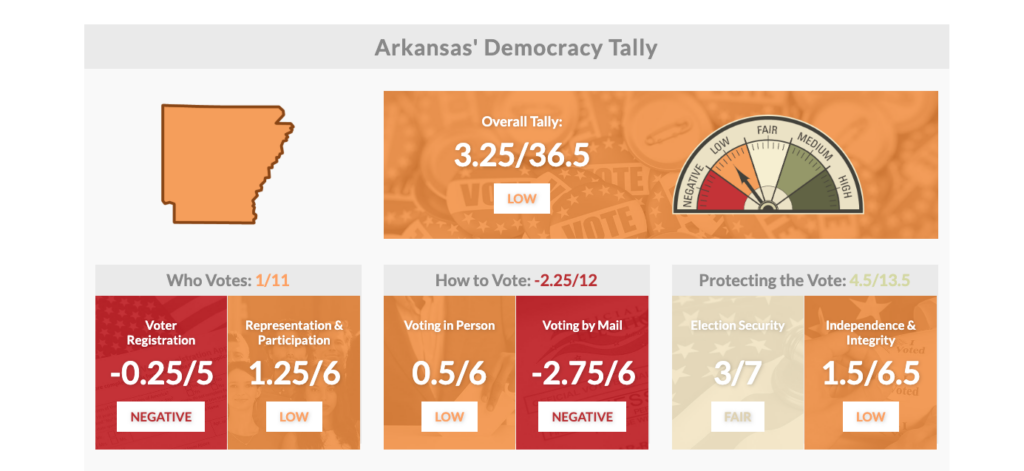
Arkansas has one of the lowest voter registration and voter turnout rates in the nation. In the 2026 March primaries, just 24% of registered voters cast a ballot. Now consider the state’s response to such abysmal voter participation: spending a quarter of a million dollars in taxpayer money just to make registering to vote even harder. It’s a head scratcher.
The backstory
Two years ago, a state-based nonprofit group launched a handy tool that allowed voters to type in their information on a digital form. They would then sign their name with a finger or stylus; the forms would be printed and submitted to the appropriate county clerk.
Sounds nice and easy, right? Turns out, state election officials dislike simplicity and efficiency. They also did not want more people registering to vote.
To counteract the tool, state election commissioners rushed out an emergency rule requiring “wet” (with a physical pen) signatures on voter registration forms, prompting the non-profit group to sue the election board in federal court.
The major problem for the State Board of Election Commissioners (SBEC) was that their own Attorney General had already contradicted their position on wet signatures. When asked by then-Secretary of State John Thurston, Attorney General Tim Griffin – himself no great friend to voting rights – issued an opinion in early 2024 explicitly stating that “an electronic signature or mark is generally valid under Arkansas law.” A digital signature perfectly satisfies the state’s voter registration requirements, given the widespread acceptance of electronic signatures and the fact that the law doesn’t restrict how a mark is made, Griffin concluded.
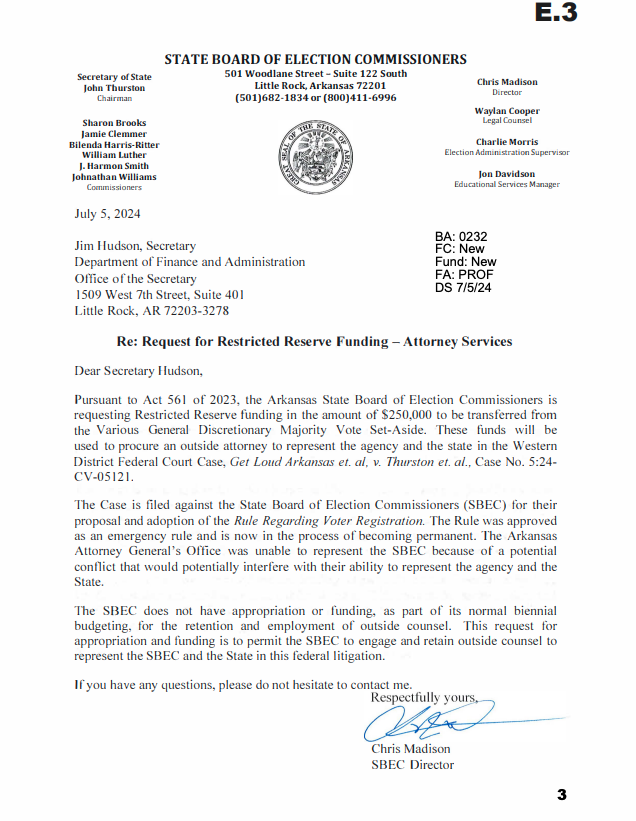
Ultimately, this meant the Attorney General was in direct conflict with the SBEC’s decision to restrict registrations to wet signatures only. This left election commissioners in need of outside counsel, to the tune of $250,000.
Last week, a panel of the 8th Circuit Court of Appeals ruled against the state, saying that digital signatures were an acceptable way to sign voter registration forms. This was a huge win for Arkansas voters.
A solution in search of a problem
The group doing the tireless work of voter registration is Get Loud Arkansas. Their nifty app helped register about 500 voters across 63 counties in a matter of months in 2024. But instead of celebrating the civic engagement accomplishment, the election commission moved quickly to shut it down.
And Arkansas taxpayers are the ones funding the state’s crusade against nonpartisan, nonprofit voter registration efforts. When the SBEC asked the Arkansas Legislative Council to appropriate funds for outside legal counsel, lawmakers happily rubber-stamped the request. As a result, $250,000 from a restricted reserve fund was allocated to pay the private Little Rock law firm Mitchell, Williams, Selig, Gates & Woodyard to represent the SBEC in court.
Similarly, the SBEC just rushed through a vote to request the full 8th Circuit Court review of the panel’s decision, called an en banc review. They didn’t spend a single second discussing the benefit of requesting such a review and or the additional cost to taxpayers.
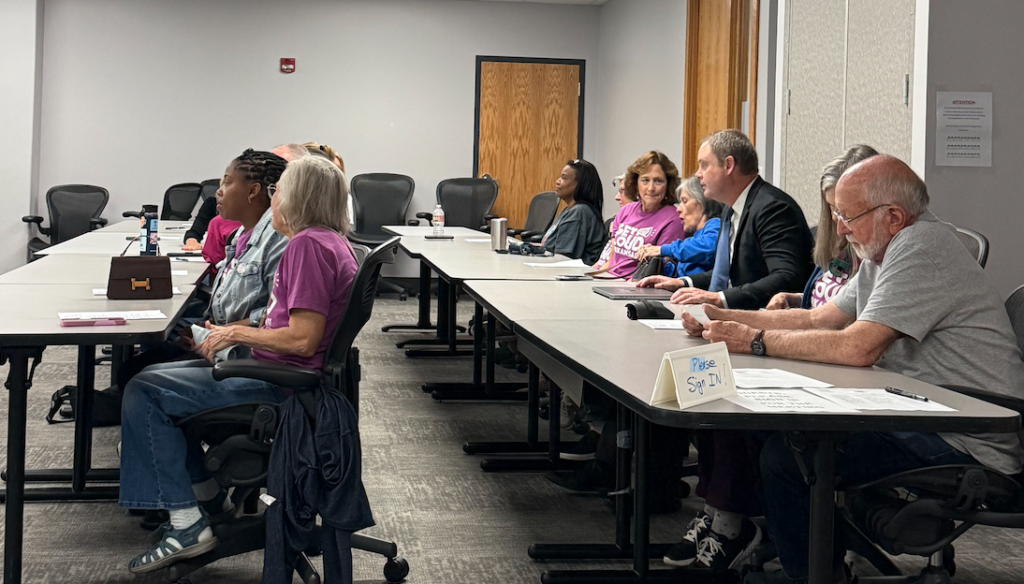
It is egregiously wasteful (and unarguably undemocratic) that Arkansas officials are spending this much energy and money for the singular purpose of quashing a nonpartisan voter registration effort. It’s silly at best. It’s wasteful and belligerent at worst.
But syphoning reserve funds to support flippant legal pursuits is the state’s modus operandi. In the same month that lawmakers handed over a quarter of a million dollars to private lawyers to suppress voter registration, another group also begged for money. The Arkansas Public Defender Commission had to ask lawmakers for funds to prevent laying off over 30 attorneys handling a backlog of 5,000 cases.
The facts lead us to one conclusion: the state does not care about election integrity or security; rather, it only cares about dismantling effective voter registration tools.
The cruelty of these expenses is magnified by our state’s shrinking public services and the defunding of public education, all while the governor pushes to eliminate the state income tax entirely. If the governor gets her wish, the state may not even have funds to pay for such legal challenges in the future.
Suppressing the vote is costly, in more ways than one
The will of the people indicates they like making voter registration easier, but the state is adept at ignoring its citizens. During the public comment period for the wet signature rule, 93% of citizen feedback strongly opposed the emergency ruling. Legislative efforts to pass online voter registration also have strong public support but face resentment from a majority of extremist lawmakers. It’s never been more clear that Arkansas wants to shrink voter participation despite the public’s will to expand it.
The election commission’s determination to get an en banc review may create even more public support for increased voter registration, accessibility, and engagement. It’s an unjustifiable legal escalation; even after being told by a federal appeals panel that they failed to provide any evidence and after being told that their own AG disagreed with their position, state officials promised more litigation. Requesting a full panel review simply wastes more public time, money, and administrative efforts on a losing cause.
The facts lead us to one conclusion: the state does not care about election integrity or security; rather, it only cares about dismantling effective voter registration tools. Officials care so much about the latter that they are willing to spend hundreds of thousands of taxpayer dollars to fight against its own citizens’ right to accessible democracy.
We must demand accountability for elected and appointed officials who spend our money on futile legal battles to defend voter suppression. It’s time for taxpayers to get mad and say NO to the state’s expensive and politically motivated legal crusades.