
This week during fiscal session in the legislature’s joint budget committee, budget hawk Rep. Frances Cavenaugh (R-Walnut Ridge) tore into State Treasurer John Thurston for the exorbitant salary increase proposed for his chief of staff. It behooves constitutional officers, Cavenaugh told Thurston, to consider who pays their salaries when drafting budgets. Paying the Treasurer’s chief of staff more than the governor pays her chief of staff is a bad look. “For me, the line is drawn,” said Cavenaugh.
When taken at face value, Cavenaugh and other GOP legislators’ comments on the grotesque salary bump are justifiably indignant. While most Arkansans struggle to get ahead or make ends meet, state employees shouldn’t bounce from job to job with a $40,000 salary increase with each lateral move. But while the AR GOP supermajority claims to be the sensible stewards of taxpayer dollars, their actual policy choices and budget actions reveal a morality chasm in state spending.

Grilling John Thurston over salary increases is merely a performative display of fiscal responsibility, which falls flat when contrasted with the GOP’s defense of other executive salaries – and most pressingly – the uncapped, skyrocking cost of universal vouchers.
The mirage of fiscal restraint (pretend penny pinching)
Frances Cavenaugh was the loudest and most persistent in her questioning of Thurston’s staff raises, but other GOP legislators were happy to join the taxpayer-protection line of questioning at the meeting. Senator Josh Bryant (R-Rogers) was keen to scold Thurston, saying the proposed raises were a bad look. How can the Treasurer use this money more fairly, he asked rhetorically, noting that some staff positions paid nearly $60,000 less just two years ago. Rep. Aaron Pilkington (R-Clarksville) agreed, and heavily questioned Thurston over what performance metrics warrant a $40,000 raise after only one year of work.
Don’t get us wrong – the line of questioning was needed and remains valid. Thurston has a history of grinding out the state grift; he first became a constitutional officer when he was elected Land Commissioner in 2011. In his second term as commissioner, Thurston faced criticism for spending about $30,000 on a boat, which was never used for its stated purpose of debris removal. Seems like he just wanted to take some joy rides on the water.
Then, Thurston hopped over to the SOS office when he was elected Secretary of State. When the office of the Treasurer became vacant, Thurston announced his plan to run for the seat. Unfortunately, Thurston knew his unaccredited Bible school degree wasn’t going to cut it for the job of state treasurer, so he quickly enrolled at UALR to get some economics courses under his belt ahead of the election.
On its face, questioning Thurston’s bananas salary increases for his chief of staff and other support personnel is more than justified. The guy has a history of milking the state system for what he can get – boats and all – and he doesn’t seem to be embarrassed about it. Kudos to him, I guess? There are a lot of state employees riding the taxpayer gravy train and private contractors enjoying sweetheart deals with state entities. But compare the fiscal hawk posturing to other legislative actions, and well, it’s an even worse look than what Thurston is doing.
The facts of fiscal indulgence (the blank check)

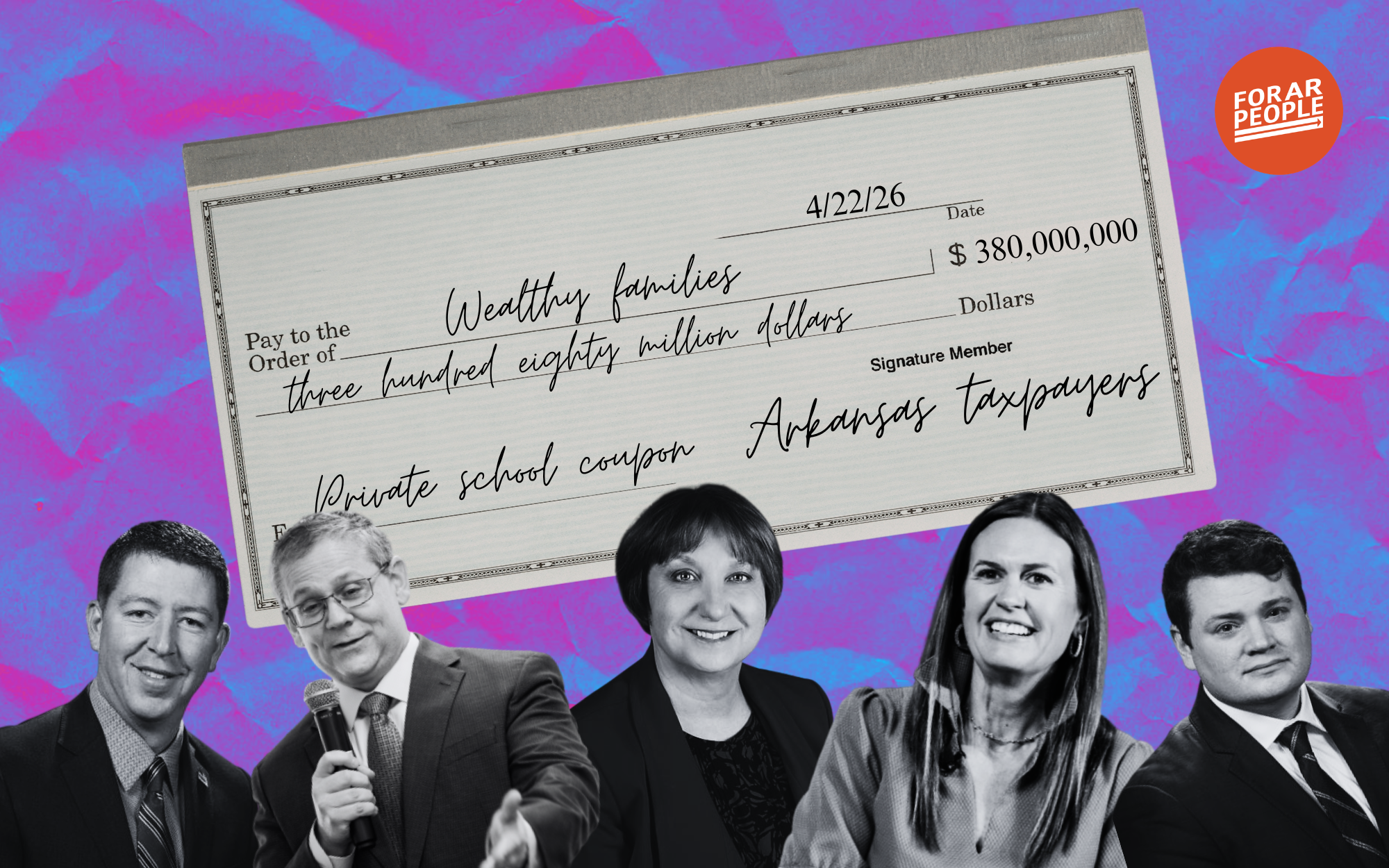
While lawmakers nickel and dime Thurston, they have essentially written a blank check for Educational Freedom Accounts, aka school vouchers. The proposed budget for EFAs includes a massive $122 million injection of taxpayer funds to the voucher program for this coming year.
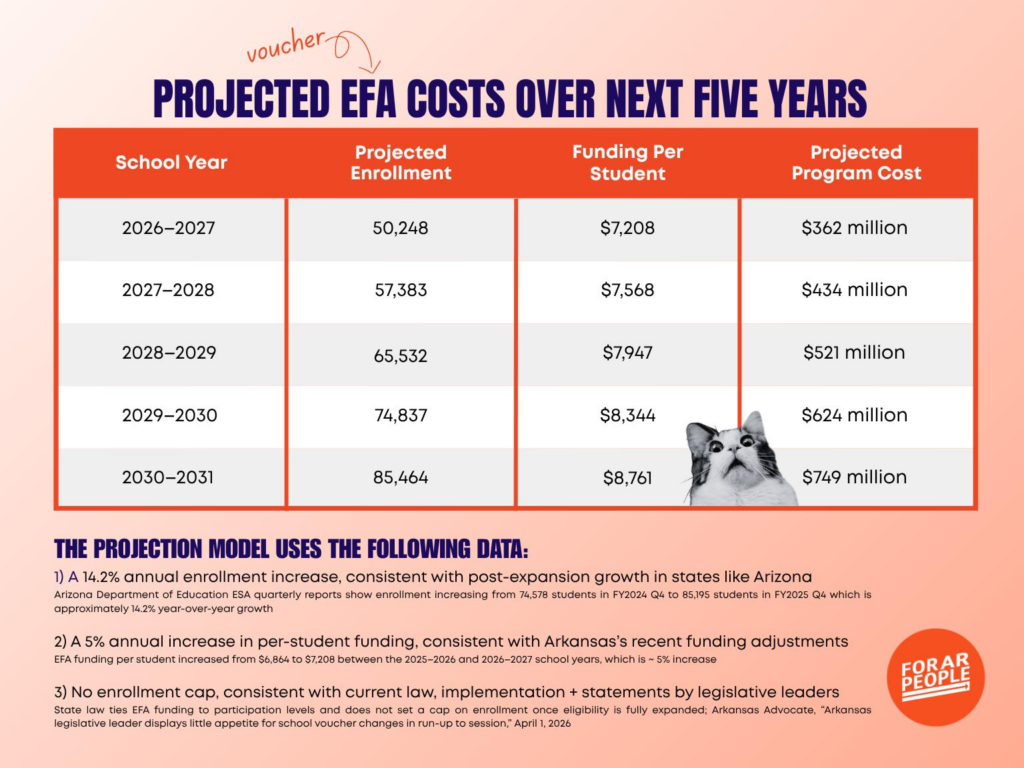
And this doesn’t include the promise to never cap spending. Another $70 million in surplus funds will go towards future expansion of the program. A fully utilized EFA program for 2027 could end up costing nearly $370 million, but even that amount is an albatross; lawmakers have also said there will be no limits on voucher enrollment whatsoever. Are we to believe an extra $70 million will cover enrollment expansion over the next five years? One conservative model we mapped shows that, even at minimal expansion year over year, vouchers could end up costing taxpayers nearly a billion dollars by 2031.
Will it matter to those who foot the bill?
To recap, this week we had lawmakers getting worked up over a $40,000 staff raise while rubber stamping $380 million for EFAs. The outrage has a very selective memory. As Sen. Bart Hester (R-Cave Springs) bluntly stated, “I will never talk about whether we spent too much for EFAs.”
Our state’s GOP supermajority cannot claim the moral high ground on fiscal responsibility while operating with a glaring, very expansive double standard. The outrage, friends, is performative; it’s a show that’s put on during election years in the hopes that voters will think of their representatives as diligent, sensible lawmakers who put taxpayers first. But it’s an act, because you can’t balk at $40,000 salary cons while praising a $380 million voucher grift. It’s proof that the appeals to honor taxpayer dollars are simply a political weapon. Long gone are the days of fiscal responsibility being a deeply held governing principle for Arkansas Republicans.