


Protect AR Rights intervenes in lawsuit to fight for direct democracy
On July 3, Protect AR Rights, the coalition supporting a ballot measure to protect the right to direct democracy in Arkansas, turned in 19,999 petition pages containing over 108,000 signatures from registered Arkansas voters.
On July 30, Secretary of State Cole Jester sent a letter to Protect AR Rights (PAR) denying their petition. He claimed that he could not count a single signature because of a discrepancy between the popular title certified by Attorney General Tim Griffin last year and the popular title printed on the petition packets.
Just one problem: Cole Jester doesn’t get to pick and choose which issues Arkansans can vote on. The people reserve that power under our Constitution; it should be in the hands of the 108,000 voters that do want to see this on their ballot in November. Cole Jester’s job is to simply administer the ballot process and to count valid signatures according to Arkansas law, not conduct an absolute joke of a “review.”
Let’s dive in to see how Jester abused the power of his office, incorrectly applied state law, and refused to release records that should have been given to PAR. Instead of acting as a neutral arbiter of our electoral process, he made himself judge, jury, and executioner for our rights.
The Process As It Should Be
Here’s how the process should work. First, the citizen-led ballot question committee (BQC) writes their proposed amendment and submits it to the Attorney General. The AG accepts or denies their proposed ballot title (not the actual text of the amendment). Once the title has been approved, the BQC can begin collecting signatures; to get on the ballot, they need 90,704 registered Arkansas voters to say “yes, we’d like to vote on this come November.” PAR achieved this without a sweat.
The BQC then turns in the signatures to the Secretary of State, whose only statutory duty is to count valid signatures in a process we call the “initial count.” Remember this point. Arkansas law has a number of provisions called “do not count” provisions. Basically, if a signature or a petition page has one of these defects, the Secretary of State can throw it out immediately, which is called “culling.” This is pretty basic stuff that you’d expect, like the page wasn’t notarized at all or the printed name is completely illegible. While it’s not explicitly in statute, the context of these provisions indicates that the Secretary should err on the side of keeping a signature, rather than throwing it out. Keep this in mind, too. If there are still at least 68,028 valid signatures (75% of the required 90,704), then the BQC gets a “cure period,” an additional 30 days to collect valid signatures to make the 90,704.
After the initial count, the Secretary then goes line by line and matches each signature to the voter rolls to determine whether or not the signatory is a registered Arkansas voter. If, at the end of this process and with the additional signatures gathered during the cure period, the BQC has gathered the 90,704 signatures, then the initiative makes the ballot and the people of Arkansas get to use their sacred right to vote to either pass or turn down the issue at the ballot box.
But as we’ve pointed out time and time again, this process has become nearly impossible over the last decade. The legislature has repeatedly enacted laws designed to criminalize canvassers, make it nearly impossible to collect signatures, allow the Attorney General or Secretary of State to throw out initiatives on tiny technicalities, and intimidate voters into refusing to sign initiatives.
Jester’s Joke of a “Review”
Incorrect “Culled” Labels and Missing Documentation
As you might imagine, a hostile and politically-motivated Secretary could find a lot of space to create difficulties for a BQC, and that’s exactly what Jester did. Even worse, he can’t really justify the review he claims to have done. The process was full of errors, inconsistencies, and bad practice.
First, Jester rejected every one of the 108,000 signatures gathered by PAR for the ballot title issue, but he did that only after counting every single one. This is poor practice because it’s intentionally designed to waste the BQC’s time. If the ballot title issue was fatal, like Jester claims, he should have let the sponsor know immediately. Instead, he used up 30 days of time that PAR could haveused for court filings, cure periods, or similar restorative measures.
But let’s look at his actual “count.” Jester told PAR that they were about 7500 signatures short of the required 90,704. But he did not provide a CSV (basically an Excel) file to PAR with the thousands of culled signatures. He also didn’t provide scans of the hundreds of petition pages he culled for mysterious issues. Let’s be clear here: he culled signatures for unclear reasons, and when PAR requested his reasoning, his response was essentially “trust me.”
Forgive us if we don’t, Cole. Trust is earned, not given.
When Jester finally sent scans over, the office did not give any reasoning for culls. Furthermore, by PAR’s count, there are at least 226 missing scans and 320 missing images from the information Jester sent. PAR and its representatives found about 199 pages that Jester labeled as “culled” but he did not identify as such in the SOS spreadsheet and did not include in the correct document folder he provided to PAR.
Murky Documentation and Unjustifiable Culls
We also have big questions about how Jester actually justified culling pages and signatures. Jester culled about 2,540 full petition pages. For 679 of those culled pages, he gave a one-word reason: “Other.” What does that mean? Jester only provided handwritten notes describing why those pages were culled, so PAR must now go line by line to determine whether the pages were properly culled or not. Let’s emphasize this point: at no point did Jester provide PAR with a good record of why certain pages and signatures were culled. Do the math: Jester culled roughly one in four petition pages for “Other”, and the public has no idea why he overrode the expression of their political will.
For AR People submitted a public records request on July 28 asking for disqualification logs, review tallies, and other relevant information. As of today, August 10, the Secretary has yet to even acknowledge that request (this is illegal, by the way).
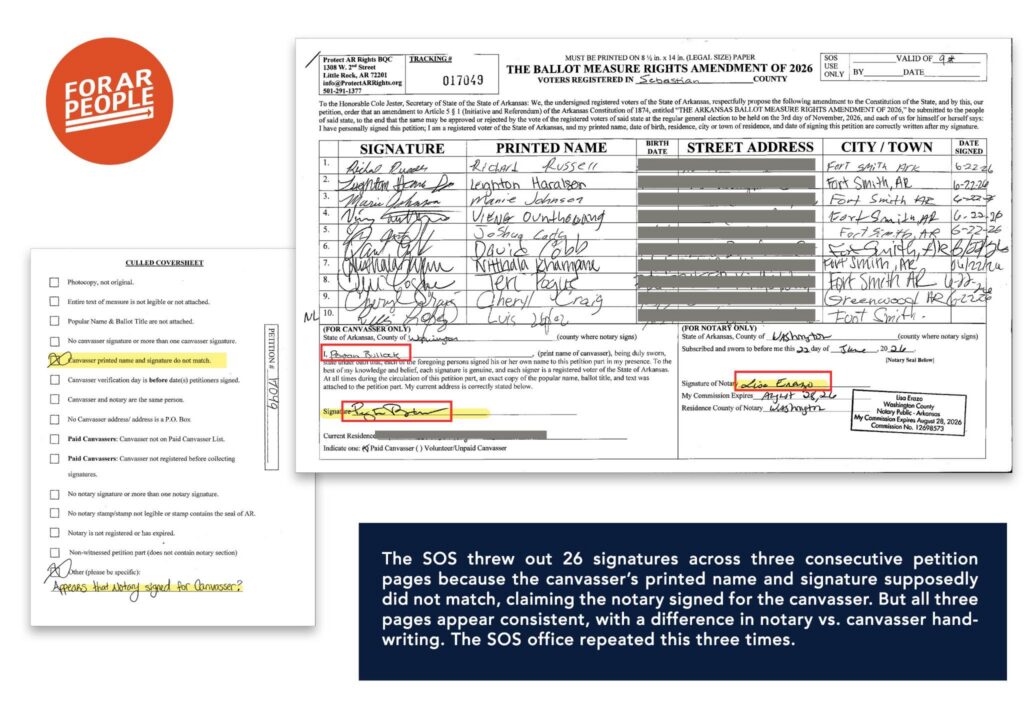
Let’s look at some individual signatures and see Jester’s justification for culling them. Jester threw out 26 signatures across three petition pages because he claimed the canvasser’s printed name and signature supposedly didn’t match, and claimed the notary signed for the canvasser. But each page appears consistent, with a pretty clear difference in handwriting. Does this look similar to you? Does it look similar enough to throw out 26 signatures from registered voters?
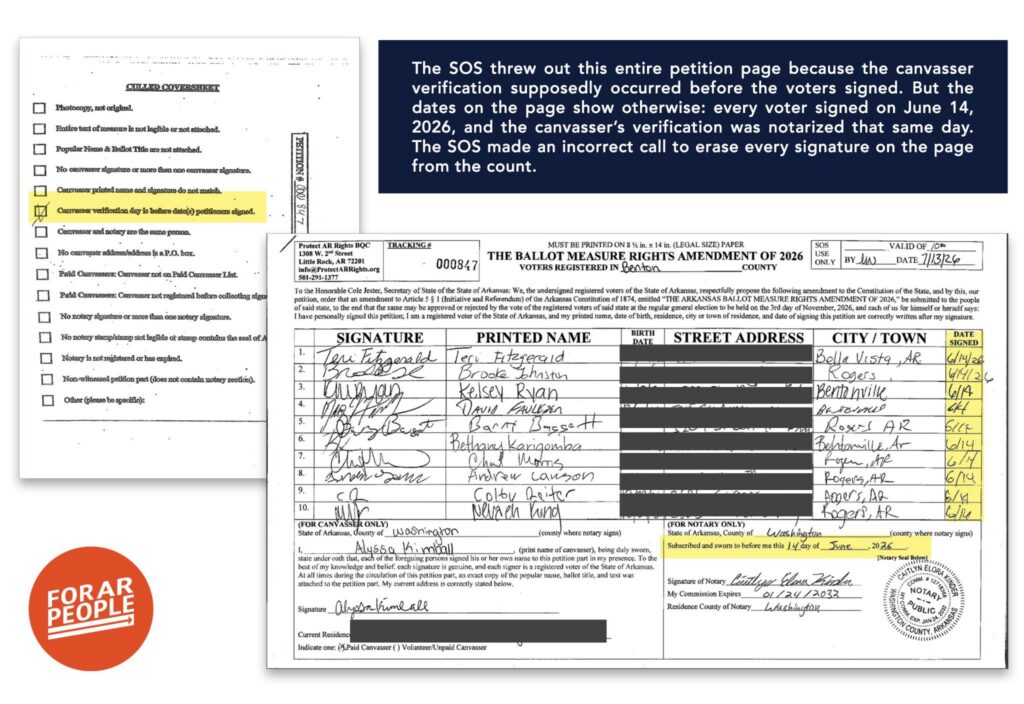
Jester threw out this page claiming that the notary stamped the page before the canvasser collected the actual signatures. But when you look at the date column, you see a straight line of June 14, the date the notary stamped it. It’s obvious this was a mass-signing event, and it’s not against the rules to notarize a page on the same day the voters signed the page. This happened more than once.
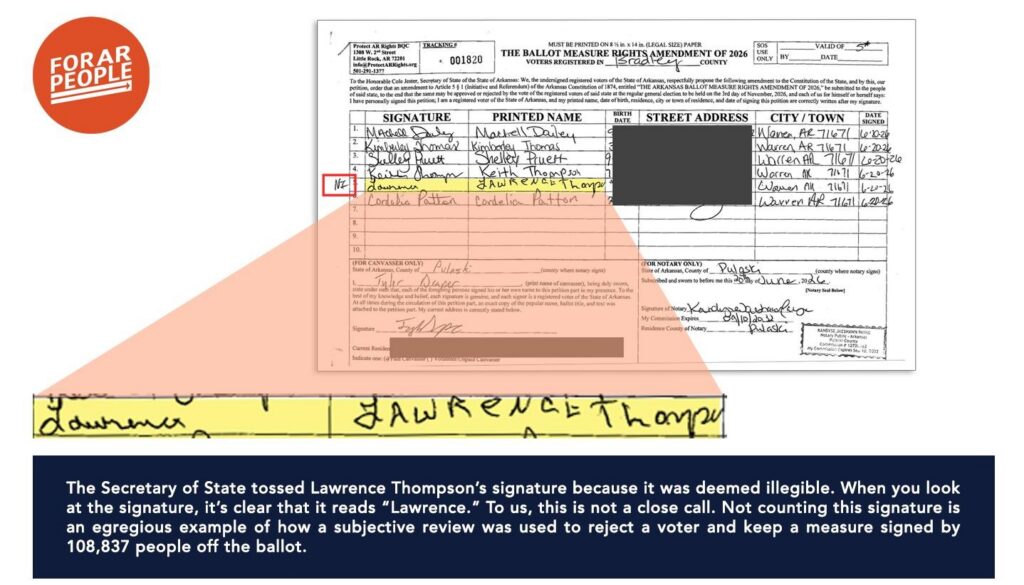
Remember how, when read in context, the “do not count” provisions indicate Jester should be biased toward approving signatures? He tossed Lawrence Thompson off this page, claiming his signature was “illegible.” Would any reasonable person look at that and not see a clear “Lawrence”? Again, this happened repeatedly.
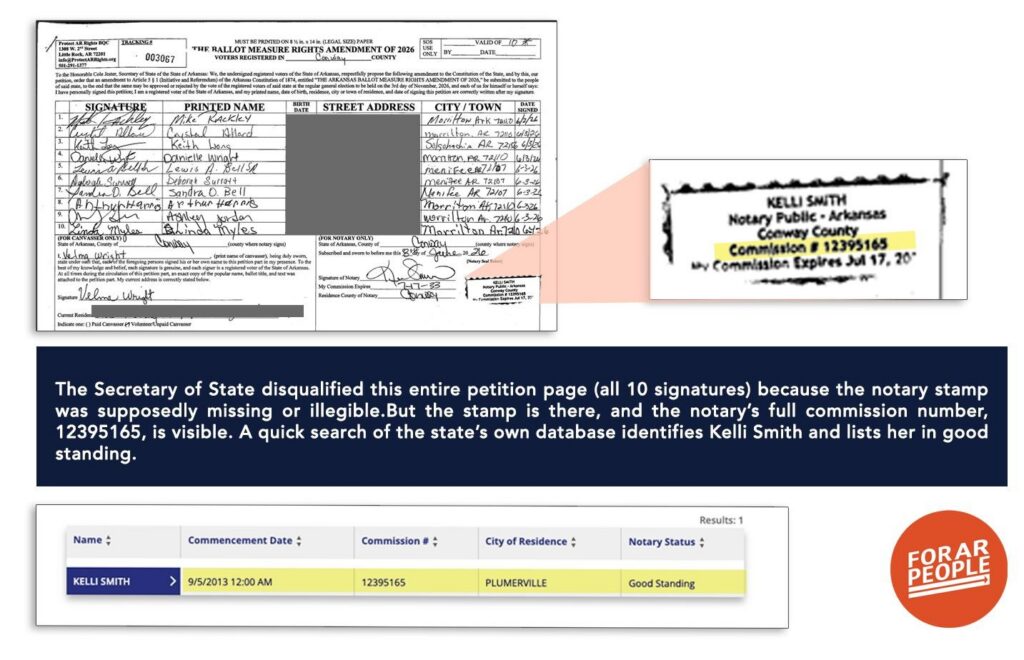
Our final example (for now – remember, Jester still hasn’t even acknowledged our FOIA request) indicates Jester happily culled entire pages because notary stamps weren’t… perfectly aligned with the page? He tossed all ten signatures here because he claimed the notary stamp was “missing or illegible.” But you can clearly see Smith’s name, county, and commission number, and she’s in good standing with the state. The stamp is obviously there and any reasonable person would find this perfectly legible.
These are just some of the more egregious culling examples we found on a first pass. We have no doubt we’ll find many, many more.
What’s Next?
Let’s be clear about something. We are not arguing that every signature, every mark on a petition page, must count. That would be absurd. We agree the process of getting an amendment on the ballot should have safeguards, rules, and regulations. It shouldn’t be easy, but neither should it be impossible. Most importantly, bureaucrats like Jester shouldn’t have unilateral authority to run a sloppy, unaccountable “review” and discard the will of the voters with a stroke of the pen.
Furthermore, Jester has been on the warpath against our right to direct democracy from the beginning of his tenure. He’s claimed “tens of thousands” of fraudulent signatures and “thousands” of duplicate signatures.
Two things here: it’s not illegal to sign again once or twice. These campaigns go for months, and it’s normal to forget if you’ve signed a petition or not. If one person signs 20 or 30 times, sure, that’s fraud. But that doesn’t happen, and Jester provided no evidence of that. Additionally, the Director of Elections for the SOS, Leslie Bellamy, made an important note about fraud in her federal court testimony in July: it’s not the office’s job to make a legal determination on whether or not an error, double signature, handwriting inconsistency or any other culled reason is fraud or perjury. The office’s job is to verify if signers are registered voters and determine if there is sufficient canvasser, notary, and signer information. An actual fraudulent signature is illegal, but Jester has never referred a signer to the Attorney General or a local prosecutor for investigation. If he had evidence of fraud, he should provide it. He has not.
Jester has an obvious political bias against the direct democracy process and used his shoddy review to claim widespread fraud to justify further crackdowns against Arkansans. Let’s be clear about that: PAR is his current target, but he’s coming for your rights as an Arkansas voter. He’s just using PAR as an excuse.
Because Protect AR Rights actually cares about the state Constitution, the group filed today to intervene in the lawsuit brought by voters last week. The group wants answers to simple questions, like “What did Jester toss out, and why did he do it?” So far, he’s been withholding answers to those questions. He thinks he’s unaccountable; we disagree.
You can read the full motion to intervene by clicking here.
Disclaimer: For AR People is a member organization of Protect AR Rights, the coalition intervening in Hanna v. Jester. Our coverage is based on court filings, public records and on-the-record sources. Legal questions about the case should be directed to Protect AR Rights’ attorneys.