
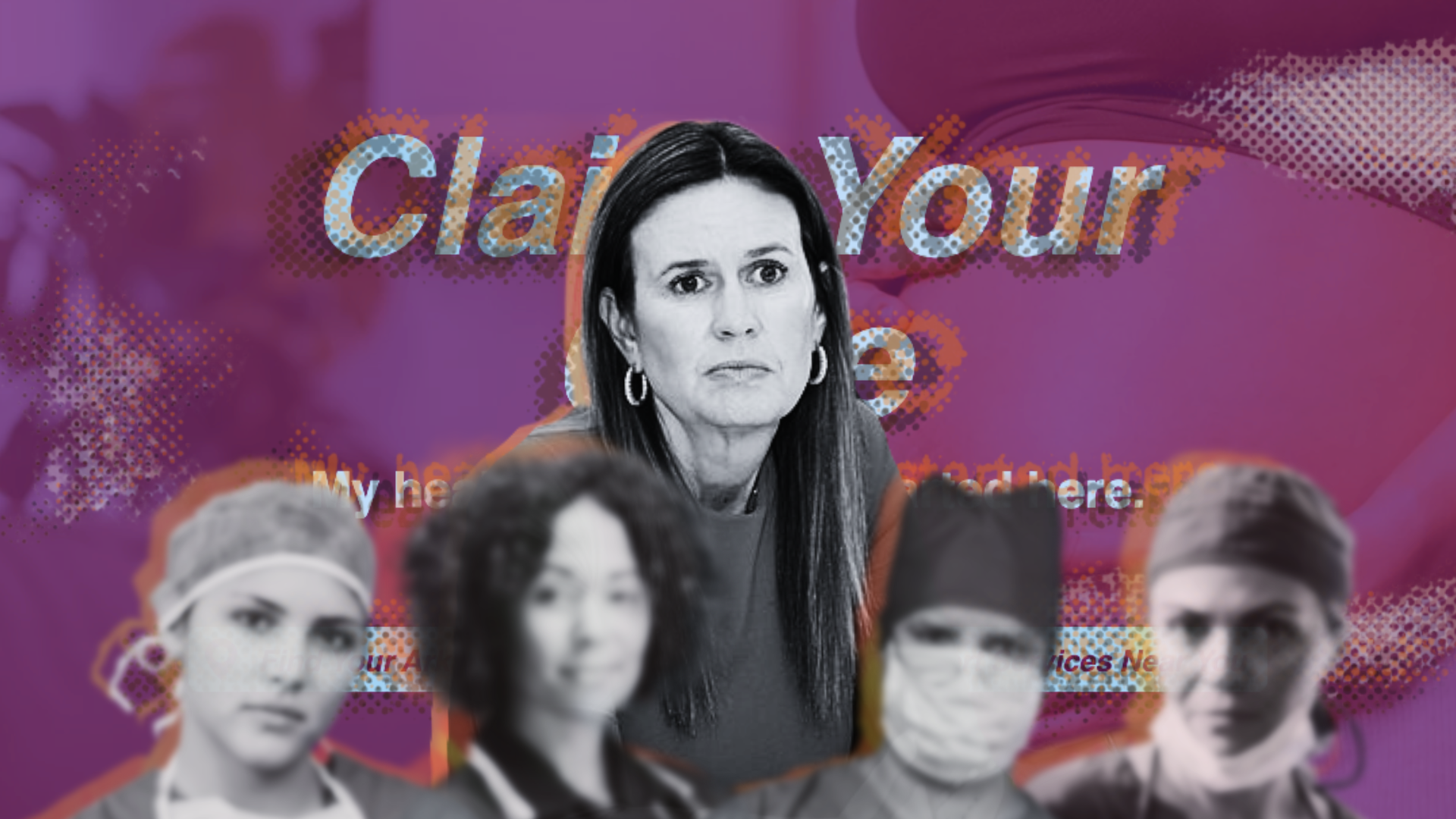
Governor Sanders’ “Claim Your Care” campaign is a marketing strategy disguised as a maternal healthcare solution.
Quick glance:
- Pregnant and postpartum women in Arkansas are dying from preventable causes
- The state acknowledges women face real barriers to care: provider shortages, hospital closures, transportation challenges, postpartum coverage gaps in insurance
- Instead of addressing access shortages, the state is spending money on a marketing campaign for Dept. of Health county units
- County units + staff do provide provide services, but they are not a substitute for OBGYN care
- Arkansas leaders refuse to implement proven policies that would save lives
Perhaps you’ve seen ads from the Claim Your Care campaign: purple and pink graphics with pregnant women showing their bare bumps, some with words like “UNAPOLOGETIC” or “FEARLESS” written across their tummies. From this promotion, one may assume the state has new opportunities for women to access critical healthcare services.

But, that’s not the case. The campaign repackages services Arkansas already offers through county health units and presents them as though the state has created meaningful new access for pregnant and postpartum women. In reality, Claim Your Care is a public awareness campaign built around a healthcare system that Arkansas leaders already know is failing women.
Arkansas Women Are Not the Problem
As we discussed in our primer on maternal healthcare, Arkansas has one of the highest maternal mortality rates in the nation. Women here die during pregnancy, childbirth, or shortly after giving birth at rates far above the national average. Our infant mortality rate is among the worst in the country as well.
As a woman in Arkansas, when I hear “Claim your Care,” the message I receive is this: Try harder! Navigate the system better! Overcome any barriers on your own! But here is the truth: women in Arkansas are not failing the healthcare system. Rather, the healthcare system is failing Arkansas women.
The state’s goal is to ensure “accessibility to comprehensive prenatal and postpartum care for all women in the state.” But their own policy handbook repeatedly documents the barriers Arkansas women face: transportation challenges, delayed care, provider shortages, poverty, housing instability, and the reality that county health units do not provide labor and delivery services.
What County Health Units Actually Do
County health units and Department of Health staff do provide important services, and many are doing incredible work with limited resources. Consequently, it’s important to be clear about where responsibility lies. The physicians, APRNs, and public health workers serving Arkansas communities are not the problem. County health units often fill gaps left by hospital closures, provider shortages, and decades of underinvestment in healthcare infrastructure. For AR People’s criticism is not directed at the people providing care.

It is, however, directed at state leaders who know the system is struggling. These leaders possess the power to strengthen our healthcare infrastructure but they have chosen to launch a marketing campaign instead of pursuing the policy changes necessary to reduce preventable maternal deaths. Transparency matters, and we must be clear about what these health units are and what they are not.
What County Health Units Do Not Do
County health units are not OB/GYN clinics. County health units are not labor and delivery hospitals. Their own policies state that pregnant women must establish relationships with outside delivery providers “as early as possible in their pregnancy” because the county health units do not provide these foundational services.
Healthcare providers across Arkansas understand this reality. That is why it’s problematic to advertise these health units as a one-stop-shop for pregnant and postpartum women when they simply cannot get full spectrum maternity care there.
Arkansas Already Knows the Solution
The most frustrating part is that our governor knows what policies have proven to reduce maternal deaths. The research is very clear on ways to solve this problem. The Department of Health’s own policies emphasize the importance of postpartum monitoring, testing, depression screening, and consistent follow-up care.

And yet, Arkansas remains the only state in the nation that has refused to extend Medicaid coverage for pregnant women to a full twelve months after birth— despite overwhelming evidence that doing so improves maternal health outcomes and reduces preventable deaths. Governor Sanders appears to be the only one standing in the way, and her refusal matters.
Pregnancy complications do not end after childbirth. In fact, many deaths happen in the weeks and months after delivery— exactly when women can suddenly lose healthcare coverage while still recovering physically, emotionally, mentally, and financially. Without stronger support systems, women across the state remain at risk.
Messaging vs. Leadership
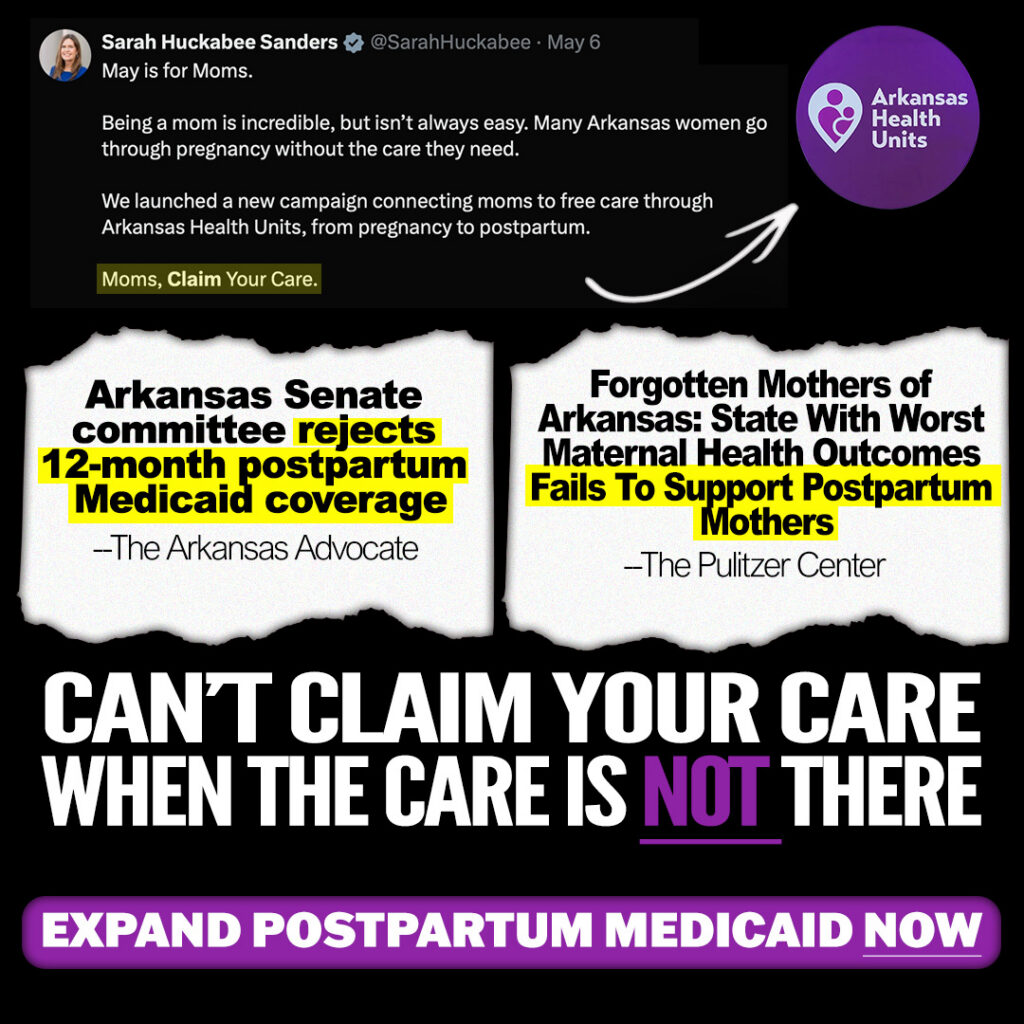
If Arkansas leaders were serious about improving maternal health, they would be addressing provider shortages, hospital closures, transportation barriers, postpartum coverage gaps, and the growing fear and legal uncertainty surrounding reproductive healthcare in this state. They would trust doctors to treat pregnancy complications before they become life-threatening emergencies. They would make sure people have choices and options regarding if and when to have a family. Instead, our state is rebranding existing, limited services with a fancy new slogan.
At some point, Arkansans need to stop confusing our Governor’s marketing prowess for meaningful leadership. Being good at messaging campaigns doesn’t save lives.
You cannot claim to care about maternal health while forcing women to navigate a collapsing healthcare system largely on their own. To borrow a phrase from anti-gun violence advocates: we do not have to live this way, and we do not have to die this way either.